


Inside Look


[ OUR SPONSOR ]
Proudly Sponsored By
Video Transcript
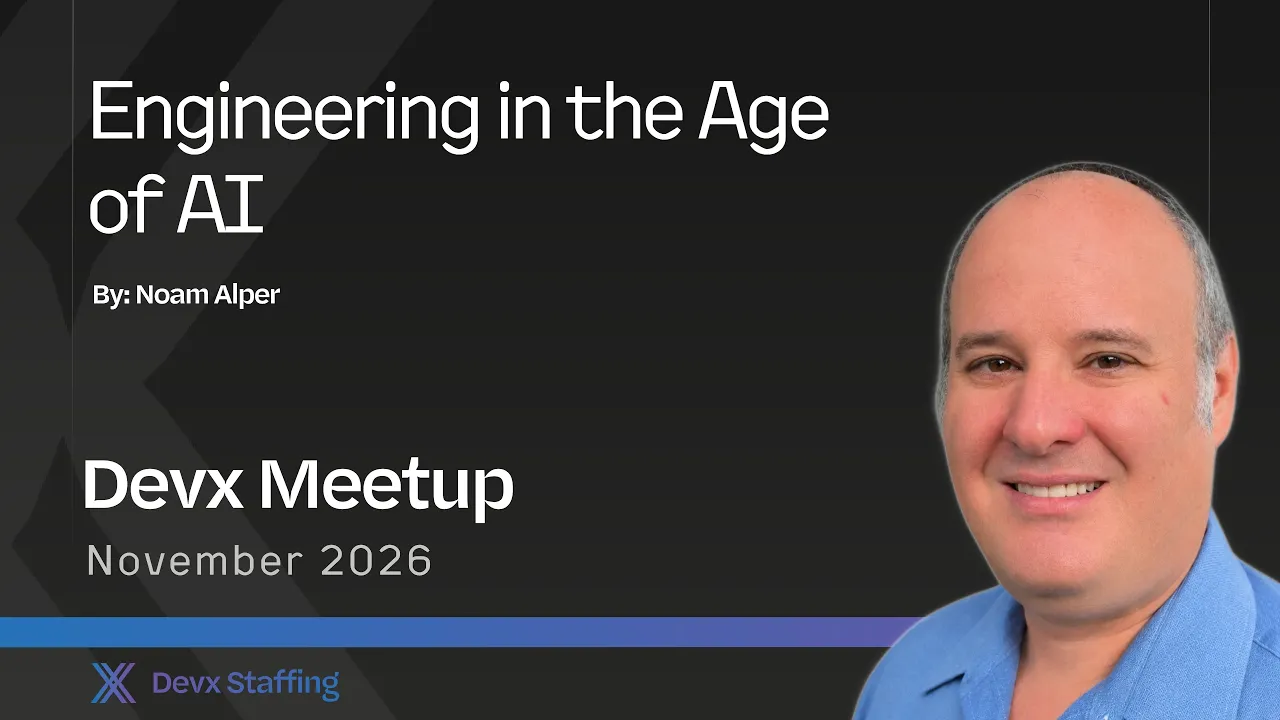
Fair amount of tech incidents over the last couple weeks, and you never know when it's gonna work or not So for the-- I know a- I know a number of you people in the room. For those who don't know me, as Ali said, my name is Noam Mapra. I'm the CTO at, uh, Omnisoft. Uh, I'll give a quick plug too. By the way, it's Omni with an E. Um, if you -- even if you don't know what ERP stands for, if you run a business, you could probably use us. So give us a look. Um, before this, I worked at Social Security for twenty-two years. I started off as a regular developer. I moved to a development team lead. I went to all the way up to systems architect. Now, I actually only read the email for this talk about two days ago, and I saw that the topic was something like building a software company in the age of AI. Fun story about me: I'm not a businessman. Uh, when I graduated college, I actually started a business in my basement, and I built high-end custom machines and did networking. And I had a really good product. Years later, I would still have people calling me up and asking me, you know, "Hey, can I-- can I get another machine?" The business failed and failed fast, not because I didn't have a good product, and not because I didn't have customers, because running a business is an actual skill, and I learned it's not what I possess, so I changed the topic, and we're gonna do engineering in the age of AI instead. And Ali said a lot of the things that I was gonna say, but One of the things that was interesting is as I was preparing this, so I wrote do- I wrote down what I wanted to say, and then I saw a couple of my favorite YouTubers and a couple people that I follow in the technology space, um, that I don't know if anybody here follows Theo Brown. He's the creator of the T, uh, T3 stack, or if you follow Potato, uh, I think her real name is Lauren Cha- uh, Lauren Tan. She wrote the React compiler, and now she, uh, programs GrokBot. They actually wound up with the exact same analogy that I'm gonna use. Um, so it's definitely something that's going around in the, in, in the space right now. The only way that I know how to tell this story, and what I think, where I think we're going, is to be extraordinarily personal, so bear with me for a minute. I have been a tech nerd my entire life. When I was eight years old, my father brought home our first computer. It was a IBM 386 PC, two megabytes of RAM, and a 2400 baud modem. I was eight years old, and I was totally hooked. I spent every waking second... All right, listen, if I'm being honest, I reserved some seconds for The Legend of Zelda and Super Mario Brothers, but short of that, I spent every waking second on that computer. When my father saw how excited I was, he went to his office and he printed out a list of bulletin board systems, and he brought it home, and he was like... He figured that it would be good for me to talk to other people in technology that were as interested about this as I was. Um, local only, because for those who don't know how bulletin boards work, this is pre-internet. You would basically, you'd, you'd dial up somebody's phone number, and their phone would go directly to their computer, and you would make a direct connection to their computer. I had a mother who was a basic Yaakov teacher. I'm sure as most of you know, I had three sisters. I did not get a lot of phone time. We had one line. And at 2400 baud, that is 2400 bits per second. Not bytes, bits. And you never actually got 2400 bits per second. You would wind up with, I don't know, 200. But, uh, 200... So what would wind up happening was you would actually connect to the system. You would watch the ASCII characters scroll line by line. It was, it was painful. There was o- obviously no pictures or anything like that, but it was a window into a whole nother, into a whole nother world. Learning the protocols, chatting with other sysops, chatting with other people that were interested in this, and a tremendous amount of learning. I loved it so much that when I was 11, I begged my parents to upgrade our modem. And sure enough, for my birthday, they bought me a 14.4k modem. One kilobyte a second. You would connect to a bulletin board, and the entire page would load. It was amazing. When you beg your parents to spend a lot of money on a modem, there's not a lot of money left for software. So I did what everybody did. I pirated. Um, By the way, I sell software now. Don't pirate. Um That modem, by the way, was the first piece of hardware I ever installed. I remember, I, I held the screwdriver like, you know, it was a holy relic, and I opened the case and I seated the card, and everything booted up. It was awesome. Before I discovered my love of real-time strategy games, the game at the time was called SimCity, and I, I loved it. Problem was the creators of the game were clever enough to put in a little bit of copyright protection, and what you would do is as you were playing the game, periodically it would say something like, "What's the population of Missouri? Turn to page 32 in the manual." Well, I had borrowed the game from a friend to copy it, so he lent me the manual. I gave it to my father, he copied it, but I was a really disorganized kid and I lost it, and there was a limit to how many times my father was gonna be willing to copy that manual for me, and that limit was one. So I had to find another way of doing this. I was on one of these bulletin boards and I was talking to somebody, and he told me, "Actually, there is a much better way." He said, "What I want you to do is go type in debug.ex- first rename SimCity.exe to SimCity.bin." I still remember this. "Then debug it. Type in debug space SimCity.bin," and you would look for a certain sequence of hex characters, and what you would do is you would change a 75 to an EB. So I'm sitting there late at night, glow of the monitor, feeling like a real hacker. I type in debug, I change the bit from a 75 to an EB. I load in the game, and sure enough, a few minutes later, "What's the population of Missouri?" I just hit enter, and it worked. I had no idea why it worked. I just knew it worked, and then I immediately had to call everybody I knew, and I was like, "Do you play SimCity? Uh, well, let me come over. I gotta do this for you." And, and then I... you know, you, you show all the hex characters, like, "I know that you can't read this, but to me, this is like English. I, I know exactly what it's saying." I went to the library and I got a book on assembly programming. And what I found out was 75 was an assembly instruction for conditional jump, meaning verify the input of what the person put in, and if it's correct, conditionally jump to here to continue the game. And if it is not correct, boot them out and make sure they don't get a chance to save first Right around this time also, I, uh, DOS started including something called QBasic on the computer, and that gave me my first window into programming. So I started doing Assembly and QBasic. QBasic, by the way, is not really as relevant as I hoped it would be later on in my career. Um, and in QBasic, it came with two games. One was Nibbles, and one was Gorilla. And of course, this is what we played in the, uh, in school. So I had to find a way to make it that my bananas, when you threw them, would be much bigger than everybody else's bananas, and just, it really sparked my love of programming One of the things that I think, you know, it's funny, I tell my children all the time, I'm like, "This is the time you have no responsibility. This is, this is the best time of your life." I think sometimes as adults what we forget though is that when you're a child, you don't really have agency. You have to do what you're told. And even though I had a, a amazing childhood, you know, there is that certainly when you get older, when you become a teenager and you think, you know, I, I know what I wanna do This gave me control. When I started programming, the computer did what I told it to do. And from the... I said, from the time I was eight, I knew that this is what I wanted to do. My first programming job, I was 17 years old, and a local rabbi had hired me. He was selling a self-help book, and he asked me to build his website, and in his website he was gonna be selling his, uh, his book. This job was way above my skill level. Um, first of all, it required web design, which Ellie will be the first to tell you, I am... That, that is not my field. Um, I, I still... I, I'm not 100% sure how you center a box, a div in the middle of a, uh... But learning CSS, uh, making that search box line up with the magnifying glass. The back end was written in PHP, an early version of PHP. For those of you who are PHP developers, I know it's a real language now. At the time, God, it was awful. When you would make a mistake, all you'd wind up with is just this white screen, and you had to start commenting out lines to figure out, you know, where it was, and write little print statements as you're going along to figure out exactly where it was that the thing was crashing. I wound up having a problem. Um, I didn't know it at the time, but it was a concurrency problem, and I didn't know how to solve it, and there was no AI. There wasn't even a Stack Overflow, and I banged my head against the, the problem for the entire day. Like, literally, the entire day. No solution. I'm sitting there later, and I went and I took a shower. I, I, I, I s- I, I remember this very clearly. I was in the middle of soaping my hair. At that time, I had hair. And the answer just came to me. It was just this explosion where everything made sense. I knew exactly how to solve it. I literally, I, I, I, I got the soap out of my hair, squirt it... I jumped out of the shower. I grabbed the towel, covered my bottom, rat... The, the shower's on the, the top floor of the house. I ran down to the basement where the computer is, and that's how my mother found me, in the basement with a towel covering myself as I'm sitting there at the computer, solving this particular problem. That feeling, more than anything, was when I knew that I wanted to be a computer programmer. I had a rabbi once that explained to me that that actually is what God is. Um, that sometimes you're studying a Gemara and you don't get it, and it's very difficult, and all of a sudden y-you see, y-y-you understand it. Everything kinda fits together. And the way HaKadosh Baruch Hu created the world, everything is perfect, and the Torah is perfect, and it's just a constant stream of understanding that you could never have. I don't know whether I should admit it or not. I never really got it from, uh, that much from the Gemara, but I definitely got it from software. That's a really long setup for what I w- w- wanted to say here. When AI coding tools first came out, I remember, I think it was, uh, the, the first version of Claude Code was using, uh, Sonnet 3.7. And I'm a tech th- I'm a tech enthusiast, I was like, "I gotta use this." It was hot garbage. The code that it produced did not compile, did not solve the problem, did nothing. So I called Elie, I'm like, "This is absolutely worthless." And he said to me, "This is the worst it's ever going to be. It's just gonna get better from here." Then they put out another version. It still didn't compile. Like, I saw where it was going. Uh, uh, uh, at OmniSoft, we, our front end is React, our back end is, uh, C#, so you need a compiler. So still didn't compile. Still couldn't do what it was, but I saw where it was going. I was like, "All right, this is still worthless." And Elie once again said to me, "This is the worst it's ever going to be." When version three came out, it compiled, and it kind of did what it was that I wanted to do on simple tasks. Now, it wasn't elegant. You know, I, I once taught a class in social security on tester and development, and in that class, I took a problem which was a prime number sieve, and by the time I was done, it was four lines of code. And we went through iteration, iteration, iteration. By the ti- it was really beautiful, well-structured code. What, what the third version of the model gave me was not pretty, but it did work And I said, "You know what? We can actually use this for some of our basic scaffolding." Now, of course, I'd written programs to do the scaffolding for me, but this was scaffolding with a little bit extra. At the time, we had an engineer working for our company. Very smart guy. A very, very smart guy, and he had a public argument with Ellie in the Slack channels. And one of the things he was saying was, "We could never use this. This is garbage. We shouldn't use it. We shouldn't rely on it. It's totally worthless because this code is more difficult in this area to maintain." And Ellie made an argument saying, "In the future, if the model is managing the code, then really what difference does it make? Code is fungible." And this developer, uh, it, it was... It's, it's really, it's a really very interesting debate. Uh, he wound up putting it on his, uh, personal GitHub page, which by the way, it's, it's never a great career move to take an argument like this, certainly when you wind up to be proven wrong later, and put it on your personal, uh, put it on your personal page I was on the fence though. I agree that we could use it for some of the non-important stuff. You know, there's a, there's an old, uh, line when it comes to hiring. I, I think it was Bill Gates who said it. He always looked to hire lazy engineers because he knew they would try to automate everything Could this do what it was that we wanted? Could the machine really code? So Ellie mentioned that we do periodically hire, and here's our hiring process. Um, first, person applies. They get screened by a low-level screener, then they meet somebody else. Assuming that they're, you know, legit, they get to me, and I give them a technical interview. And a technical interview is- It depends how it goes. Um, if the person does very well in the technical interview, I give them a task. And the task that I give them to do is to take home, I say, "You pick... I'm gonna give you 24 hours. You pick the 24 hours that works for you. You don't have to finish everything on this task because it's a particularly long task. Do what you can. Don't work more than five hours, and then just send me a note, 'This is what I didn't complete.' And just make sure that it's your very best work, because if you do everything but submit to me garbage, I'm not... You know, you're not gonna get a call back. But if you don't submit everything, but it's, it's very good, you know." We had an engineer who applied for Microsoft, and I gave them the task, and I got the nastiest email back. Like, "How dare you waste my entire day on this ridiculously difficult task?" Like, literally, and I'm reading this, I'm like, "Well, I'm not hiring you." Model three, when it attempted to, uh, to solve my task, s- it still didn't compile On my birthday, Opus 4.7 came out, and it completed my task in nine minutes. This woman said she spent 22 hours on it. Now, I don't believe her, but I do, I do know plenty of people that... 'Cause I could see their Git commit history as they were submitting it. Plenty of people spent 10, 12, 14 hours. 4.7 did it in nine minutes. And when I went to Elie, I called Elie up as soon as it... 'Cause it, the, the first thing I did every time a new model came out was I ran it against my task to see how it did, and I would always call Elie. I'm like, "You can't solve my task." I'm like, "It solved my task in nine minutes, and it's pretty good." And Elie looked at me and he said, "And this is the worst it's ever going to be." I put 30 years into learning to be a good developer. I am really good, in all humility. Um, and all of a sudden, a machine could do what it is that I really spent a good chunk of my... dedicated a good chunk of my life to, to trying to perfect And the more I used it, the more productive I got. I was producing 10 times the amount that I was before I was using it. But that feeling that I got, that time in the shower, that feeling that I got consistently when I worked, that solving it, that fitting the pieces together, that kind of went away, and it was kind of depressing. And I remember talking to my wife saying something along the lines of, I really wanted AI to do my laundry, not my creative tasks that I enjoy So Ali said something when he was talking a minute ago, and let me be more blunt about it. Any engineer that is not using these tools and these practices will not have a job next year. You may have some sort of a specialized skill that only you know, working in some language that they ca- that they can't feed to the AI for whatever reason, but short of that, anyone who is not using these tools... We have a- another person, one, one of the people that we work with, he's from Latvia. Um, one of the smartest guys that, that, that I've ever met. I- the, the kid is brilliant. Um, I call him a kid, I think he's around my age. Uh, we once... I, I once had a debate with him. We were talking, um, we, we both came from the Assembly and then the C world, and he was doing some low-level bit manipulation, and I was telling a different way to do it, and we were going back and forth, and I sh- I sent him an article from Microsoft saying, "What you're doing, the framework says it takes an extra three steps." And he said, "The article's wrong." I'm like, "They wrote the framework. They wrote the article." And then he showed me, he decompiled the Assembly and we went through the as- the, the, the MSIL of the C# code at the Assembly level, and he was right. Like, he is that brilliant, and he is getting outrun by people with a quarter of his skill. And the code that they're generating... All right, half his skill. Sorry. Ali just mentioned cost per feature. I had one... I was in a meeting. Every, every Friday, I meet with each one of my team leads to ask them what they accomplished over the week, and I was explaining to him, like, "Listen, this was not a particularly good week for this team. You know, I expected you to get here, and you only got here." And he said, "Well, you know what? If you gave me three more cloud code subscriptions, I could do it, but otherwise, this is what it's gonna take." And I said, "If all you need is three more cloud code subscriptions, I don't even have to ask. Ali approved. You're, you're telling me it's gonna take an extra three weeks, what Ali's gonna spend on salary in those three weeks, you know, the $600 is nothing You see, a lot of software engineers, myself included, thought a big part of our job was writing code. But the truth is, that was never the job of a software engineer. The job of a software engineer was solving a problem. Now, the method or the methodology we did that through was through code. But I never sat with a client who said, "I see that you used the repository pattern here, and I'd prefer you use the visitor pattern." That never happened. I never sat with a client who said, "You know, I really want you to use Ruby." I mean, c- everyone else. Uh, considering the problems with Java they had this week, then there, there may be clients who say, "Don't use Java." But Just as an aside, one of the things that I th- I, you know, I just mentioned at the beginning of the talk some of the YouTubers that I follow, and they're all, you know, JavaScript, TypeScript. I was one of those people who used to say for very many years, I believe that Brendan Eich, when he created JavaScript, he looked at every other computer programming language, and he said, "What problems do each of these language have?" And then he said, "You know what? I bet you I can create a language that has the problems of everybody." And he wrote JavaScript. What the... Triple equals, God, it drives me nuts But one of the people that the, the, the area of, that I think the people adapted the quickest was actually the JavaScript TypeScript developers. I think one of the reasons is their ecosystem was accustomed to rapid change. I mean, how many JavaScript frameworks come out per day? They had to keep on top of this, and I think that gave them a leg up when it came to keeping grab to h- uh, keeping on track of all of the new things. As, uh, as Ellie mentioned, we're doing things that you couldn't do six months ago, couldn't do three months ago What is the job of software engineer nowadays? And I'm gonna make an argument, and I know it's gonna offend half the room. But again, it's the same argument that I've been hearing from a lot of other people. We are now gardeners. And gardeners come into two different things. It's weed pulling, and it's putting stakes in the ground to make sure that what we're doing grows straight and true And the truth is, this was always a part of our job, just less. Let me give you an example. Three years ago, I had an engineer. We hired a new engineer. Whenever I- whenever we hire a new person, I tell them three things on day one. I say, "This is your day one goal, this is your week one goal, this is your month one goal, and I'm going to be checking up." And mon- and his week one goal happened to be he had to have a certain API finished. And when he submitted to me that PR- that PR, I looked at the PR, and I'm like, "What in the world were you doing? This doesn't make any sense at all. Did you look at any of our other code?" And he said, "Yes, matter of fact, I did. I looked at this API. I thought it was similar, so I copied it." And I looked at the API that he was looking at, and he was 100% right. Because we had 99 APIs that were written this way, and we had one that was written this way, and he happened to pick that one. So the first thing I did was I rejected his PR, and then I immediately went and made a follow-up PR. It took me a day and a half to rewrite that whole thing, add zero functionality to our program. Zero. It... The... What worked before, you know, I mentioned that I was a big fan of testers and development. Well, I had great unit tests, so I was able to refactor, and I was able to refactor knowing that I would still have all the functionality I had before, and I refactored into the pattern that we're using nowadays. And again, it was totally worth it. Because he stumbled on that code, he made a understandable, uh, mistake, and it had to be fixed. That is gardening That thing that took me a day and a half to do, now would be a prompt that would be done in 10 minutes. I would tell the AI, "Look at this API, now look at all of these. Restructure it to match this pattern." And while it was doing that, I would be doing 10 other things. It took me a day and a half, and now it wouldn't take me more than two minutes, and it wouldn't take the AI more than 10. Because here's the thing, slop grows a lot faster than weeds, and it matters so much more because as a human, he had to stumble on that code. The AI is gonna see it every day. The AI is gonna see it constantly, and it's gonna make mistake after mistake after mistake. And let's be honest for a second about where slop comes from, because I have written my fair share. Uh, one of the things I did when I was at Social Security, I wr- I hand-rolled my own TCP/IP server using named pipe connections in C. I was the only person on the team that understood it, which meant that every time there was a problem, the entire team was blocked by it instead of simply using, uh, a well-known framework. So I've written slop. Sonnet 3.7 has written slop. And if we're be-- And if Opus 5.5 is being blocked by Sonnet 5-- 4.5 slop that was done last month, well, then those weeds have to be pulled. There is constant maintenance that has to come. So here's what some of that pulling weeds looks like. We had an-- We had, uh... I, I approved the pull request two weeks ago. Hundred and ninety-five files deleted, ten, uh, ten thousand eight hundred lines changing API patterns, 19 dead end points, fifteen thousand code re-- five thousand tests deleted. I winded up having to bring four of them back 'cause there was a small... But five... And, and, and we'll talk about why that matters in a minute That brings us to our next thing. Gardening is not simply about pulling weeds. Sometimes it's about putting stakes in the ground. My boss has a particular thing about description fields. He believes that a description field should contain enough data that if a person wanted to put the entire Library of Congress in there, it should fit. Every one of my engineers thinks a description field should be max of 500 characters, and this is literally the bane of Ellie's existence. So I had, I had a company meeting, and that, uh, to, to explain what a company meeting means, it means the entire company has to stop and join me for the meeting where Ellie could tell you by the second what that costs and I have to tell everybody, "Description fields are unlimited, period, end of story." And then the next day I saw a PR that had a varchar of 500. And I called the guy, I'm like, "What did you do here?" And he said to me, "I, I don't know why the AI did that. I, I have it in my cloud.md file now that, that, that, that... I don't know why it did that." Well, it did that because it was somewhere else in the code. It did that because now the AIs have a memory. And it-- just because you didn't put it into this context, it got it from another piece of context. So what happened? I tasked one of my engineers, Sean. I said, "Fix it. This doesn't happen again. I never ever see a PR with this again." So what did he do? He wrote a task into our pipeline that looks for description fields and uses the AI to figure out what is a description field and then looks to see if we've limited it somehow, and if it does, it fails. And when the AI attempts to build the code, it breaks at the build point. That is a stake in the ground to make sure the plant grows. Now, Ellie, I'm not gonna promise you you're never gonna see a description field that's limited, but we, we are, we are trying. 100,000 characters. 100,000 characters. Our cloud.md files are stakes too. We give instructions. Ours say things like, "Never put an internal note into the documentation." Why? Because we saw things where we were putting internal notes in and it was winding up in the Swagger docs. They become public. Same with database migrations. We have drift check built into our database migrations. Nobody needs to remember to check. And when the agent attempts to build it, it will fail because the agent will do it. We, we, we've seen it happen over and over again. Because the truth is friction always slow us down Agents get stuck a lot harder than we do I looked this up here before we came. In September of 2025, my team as a company, we merged 54 pull requests. In October of 2026, we merged 989. In September of 2025, it took about 30 to 45 minutes to run through our entire CI pipeline. Okay, so you start the CI pipeline, you go make yourself a cup of coffee, you drink the coffee, come back, you know, watch it run. Lots of fun 989 pull requests that are coming in, it's not o- one person is slowed down. 10 agents get stuck, and then the company just stops. CI at, at that rate, CI is no longer annoying, it bottlenecks the entire company. So what do we do? We need weeding. We need stakes in the ground. We need to make sure that our CI pipeline is just firing on... It's, it can't take more than five minutes. It simply can't. And then we have to find another way to do it. We have to have another way to parallelize the jobs. All of that is gardening, and all of that is what we do now. And when we did that, the bottleneck moved. All of a sudden, the bottleneck turned from the engineering side to an area that we didn't predict initially. It turned to the BA and design side. Because here's the thing, the only person who really knows what we wanna build is that guy in the corner over there. And everything... He would ask questions, and be like, "All right, well, what's the answer?" And E- E- Eli would have to sit and stop and answer questions because we were doing so much. Again, 54 pull requests, you can field those questions. 989? Nobody can answer all that many questions. So we wound up with this big bottleneck. Who here has read the, uh, Isaac Asimov Foundation series? All right. So Eli created what he calls the Prime Radiant. And what the Prime Radiant does is it trolls all of our Slack, all of our wikis, all of our meetings, all of our transcripts, all of everything, and compiles everything down into decision pages. In the Prime Radiant, we have 15,500 decisions, over 10,000 sources, hours and hours and hours of ruling. And now our agents, when they have a question, before they ask us, they query the Prime Radiant. I'm looking at the amount of times the Radiant is queried per day. In our small company, we're querying it tens of thousands of times a day. And now we have the answers that we need. And of course, if the Radiant doesn't have an answer, it raises a flag to the person... It, it, it could know who is the person who should be the subject matter expert on this, and it could raise a message to them saying, "There is a decision that needs your ruling." It's wired into all of our tooling. But there's one other thing. Then there's the work that was never worth doing. Like, I'll give you an example. Um, when we initially created our database structures, all of our primary keys were integers. Makes sense. Integers are fast, they're sequential. When we were doing imports and other things, we decided that the best structure for this would actually be to do UUID V7, which didn't exist when we started, uh, our database structures. Because UUID V7, because it's ti- it's not really sequential, but because of the way its timestamp works, it's kind of sequential, and you can kind of do the predictable pattern. You can do an import, and when you're doing an import, you can create the ID known before you have to insert into the data. All sorts of benefits. I had thousands of database tables. There's no way. And as I told you, I'm a believer in test-driven development, which meant that I had 100,000 tests that tested those tables. There was no way I was ever going to do a migration to migrate the entire system from IDs. I-- What I would have to do is I'd have to split work and say, "Okay, these tables are using UUID V7. These tables are using integers." And then we would-- We'd have a bifurcation of the way we were storing data, and that would confuse our agents. This was the way that I wound up testing every new model when it came out. I said, "Can you do this migration for me?" It would've ta- i- if Ellie would've asked me, "Noam, how long will it take you to do that migration?" I would say seven weeks Fable did it in about six hours. The first time I had it run, it ran for three days. This was the first version of Fable. It ran for three days and didn't complete. The next time, it did it in six hours. So all of a sudden, these things that weren't worth doing in the past... By the way, when, when it did that, it touched over 5,000 file- I- the, the PR was something like 250,000 lines of code. It was crazy. But it completed it And it's not just the migrations. One of the things that you see on my team right now, every single person that works for me has written some sort of a command center or a launch pad or something like that, and the reason that they've done that is we're flowing so much data. Like, it used to be, again, 50 pull requests and you can monitor your Slack. Your... How many messages are you gonna get a day? It's rare that I get less than 1,000 messages in a day. There's no way anybody can monitor that. When I look at the amount of it, and I have to monitor that, and I have to monitor the wiki, and I have to monitor GitHub, and I have to monitor all the other places that people communicate with me. I have to monitor Jira. So we all have built custom tooling to deal with this That simply wasn't possible before. It wasn't, it would- y- you wouldn't have been able to dedicate the time to making fun little apps. Mine actually... So Claude prioritizes my list for me, but I have other things in there like, uh, I've got a, i- i- if, if some of my tasks last too long, I get a little boss fight guy and I, you know, battle it out. I have a little roulette wheel that will spin me when I want, you know, just the next task to work on, not in priority order And when that happened, all of a sudden I got that feeling back. It wasn't like it was before. It wasn't like it was, I said, when I was 17 But when I see where the bottlenecks are and I see what's not working, and all of a sudden I find the right weed to pull, and all of a sudden I see everything start flowing, that same feeling that I experienced t- on a different level comes back. You know, I-- when I was a kid, I used to love playing with Legos. And what we've really done is, what the AI has given us is simply bigger bricks, and how we put them together and how we build our garden and how we let it grow. So again, I'm, I wasn't really sure the audience for this talk, which is why I, I tried to make it the experience that I went through using these tools and some of the ways that we're using it here at OmniSoft. Um, but it's also... One of the things I wanted to convey is, I know i-if, if-- assuming that a number of people here are developers, I'm assuming that many people went through the same kind of mourning period that I went through. You know, um, do I believe that the... You know, I, I, I saw recently, uh, Anthropic said ninety percent of their code is written by Claude. I don't believe that. I believe it's significantly higher, um, because I know what we're doing. I know in the last twelve months how m- how much code I've written for our company by hand. I have side projects where I still code because I, 'cause I do love it. But the, it's simply, it's, it's not a good use of my time You know, uh, do it, do handma- I, I saw somebody, I, I saw this in a talk recently. Do handmade leather Italian shoemakers still exist? Sure, but look at your feet. Do I believe that people are going to be handwriting code very much longer? No, I don't. And if you've gone through a similar mourning period to the one that I went through, I think the best way to look at it is the excitement of what is possible that was simply not before. It's not simply about being productive. It's about what you can do that you simply couldn't do before. And that's really, uh Any questions? Actually, uh, I don't know what the word is, by hand reviewing your PRs? What an excellent question. Okay. So if anybody didn't hear, the question is, he said, "I saw that there was a varchar field in there. Am I by hand reviewing it?" When I have people submitting to me PRs that are, let's say, a hundred thousand lines, realistically, there's no way to hand review this. It, it can't be done. Uh, a hundred thousand fi-- hundred thousand lines of code, meaning even if I could theoretically keep all of that context in my head, um, it would take me months. So we do rely on agents to do a lot of our PR reviews. What we do is in our pipeline, and some of this is still in experimental, we have an agent that goes through it and then tells us what the blast radius of these changes are. So it says, okay, if the blast radius is relatively small and we can prove it, meaning I have something working on my computer right now, that what I do is, let's say I've got a, um... We, we have a bug list like anybody else. Um- Okay. We have no bugs. No. Uh, and I'll have the agent go, and what the agent will do is it will fix the bug, and then it will pop the browser, and it'll take a video, and it will automate showing that the bug has been fixed. And then it'll attach that to the PR, and then I can view it, saying that, that it's been fixed. So when I say that I saw that it was a varchar, I do spot reviews. But the first thing that I do is I, I run my agent against it and I say... And I've got special skills for dealing with the PR, depending on what it is. Is it a front-end PR? Is it a back-end PR? Does it touch both? Does it touch our mobile application? So my skills go against the PR, and they categorize it, and they give me areas to look at. And what I generally do wind up looking at, though, is the database. So I wind up... So it happened to be that I saw in that one, in the schema, that somebody had put in a varchar there, so I knew right off the bat. And it also happens to be that my agent, because my agent queries the Prime radian, knows to look for that type of thing, the things that don't fit the, uh, description fields Excellent point. Okay, what agent harnesses we're using. So if you asked Ellie, he uses really very heavily... He, he, he buys into the, the mainstream, uh, for, for, for GPT, he uses, uh, Codex, and for Claude, he uses Claude. I love T3. Um, um, I, as, as I mentioned, I, I like a lot of what Theo Brown does. I like the ability to- I, I use Arch. No. Tax. Yeah. Um, the truth is I re- I, on my, on my home machine I run Pop!_32. But anyways, I, I'm a big fan of T3. I would encourage you, uh, Theo Brown actually put out a great video, and it's about an hour long, that shows all the functionality that T3 gives you that you don't get from your, from the regular applications, including mixing and matching agents inside the same, uh, inside the same thread or bringing in one thread to another. Excuse me. It's server... I get out of here. It's the, the, the way it, its ability to use the server and to connect it with a... Like I, it's, it's a really bad habit, and boy does my wife hate it, but I'll be sitting there, you know, midnight on my phone s- sending off my agents or checking on their results or, or whatever it is. Um, now when it comes to Claude in particular, so Claude is only gonna allow their harness. So what they do is under the covers it's calling the Claude executables to manipulate its stuff, which means that T3 when it comes to computer use doesn't do as good a job with Claude as it does with all of the other models. But my T3 is hooked up with it's got Muse, it's got Grok, it's got Claude, it's got Jeopardy. You know, it's got a whole bunch of different ones in there, and often, you know, we, we ju- we just talked about reviewing, so I have a whole review panel that goes through and, you know, the structural architect and the so forth and so on. But that, that is mostly what I use. I, I did use OpenCode for a while, but for whatever reason, it, it was great for a while, and then it just went downhill So, I mean, if you're doing a back end, you can still write tests yourself, but you could also have Claude write the tests yourself. You're not gonna under-- you're not gonna be able to understand all the code it writes. So in, in the past, we would be testing the code we write. We can't test the code we write. Claude can test the code for us. So how do we test the tests? How do we make sure that it's do- that it's So another great question. So two things. First of all, agents love to write tests. One of the things that we found was that I... When, when, when I removed those 5,000 tests, one of the things that I did was I told my developers, I looked at who was, who was the biggest offenders of adding what I considered to be slop and useless tests that were not benefiting the system, they were just tests. And then I said, "Go back to the thread, and you ask the agent, 'Why did you add this test?' And then you correct it." And it's a constant state, uh, uh, of iteration. You know, um, one of the things that we're doing, and I, I apologize if this doesn't completely answer your question, but I'm getting there, I promise you. Um, Eli created a bunch of different skills that he uses to test our modules, and some of what these skills do when we're looking for bugs, you know, it automates the browser, and it looks in Jira, and it follows all the acceptance criteria, and it checks all the, all the sources and goes through, and it clicks on every button, and it, you know, so forth and so on. When he said, you know, we've automated monkey testing, so that's what he means. The, the... Every single button is clicked, every single scenario is tested. And Eli, I think, what are you on, version 89 of that? Something like that. Because what winds up happening is something falls through, and then you ask the agent, "Why'd you miss this?" Or, "Why did you do this?" Or so forth and so on, and then you keep iterating on it and you improve it. Okay. So how do we test the tests? Um, Potato actually recently put out a, a, an amazing piece specifically on that, on the fact that the test should be testing the functionality and automating the test to make... to test the functionality. When it comes to all of those tests, y- the, the best that I can tell you, because I do this extraordinarily frequently, is see what... where the tests are hitting. You know, I have my agents go through it, but I also, I have other automated tools that I've written with my agents and some that I've written by hand, but not so much anymore, that go through and they see where the tests are hitting, what lines are being, not so much cov- code coverage, but what are actually being useful, and I see what actually fails when I make changes, and then I iterate upon that. Does that cover it all? Well, let's go to the next- build your business Before the, before the Prime Radiance, and I really don't, I, I really don't wanna grow his head at all, but the the... He, he, he pulled me into Goldberg's one morning, and he's like, "We have to build this. We have to build this now." And I'm like, "I don't have the time for this right now. I have to ship my first release." And he said, "Noam, this is more important than your first release. It has to be built and it had to be built now." And he was right, because once- Once we got all of that information into one place and we built an MCP server that it was queryable, it gave us the information that we needed because the... One of the things that happened, I think this has happened with every company that I've ever been a part of, is drift, where the, the business requirements are such, and then the engineer comes up to the analyst and says, "Okay, uh, but this... It would be better if we do it this way." And the analyst thinks about it and says, "All right, let's do it that way." But the user story didn't get changed. And then when it goes through testing, all of a sudden, it's a bug, and the tester says, "I've identified a bug." He said, "No, I had a conversation with this guy and we changed it. It's supposed to be like that." What that really does is it manage... It, it monitors drift, and we have our agents that go through. And I said, they, they read every message in Slack, and they go through every one of our meetings. It goes through every transcript of our meeting, and it goes... And so forth and so on. It gathers all of our sources, and it creates this knowledge base that is, one, queryable, and two, queryable by agent What do you, in the actual validation? So it's there Right. You know, the fact is you're not... Are you-- Is anyone ever auditing it? You know, the, the... You thought that that was the end of the meeting. It turns out John and Tim both disagreed about what the actual conclusion was, and the knowledge base is wrong. So you're basing it all off the potential of AI thinking that actually understands the message when people don't really understand. That is a great question, and there is organizational priority. For example, John and Tim have an argument, and they say one thing, they say another thing, and then Ellie said a third thing. The Prime Radian is smart enough to know that Ellie is the decision-maker, then go with it. And what do you do when you have a problem with a decision tree? So first of all, our, our wik-- our, our... The Prime Radian is based on, uh, Kaspersky's, uh, a wiki for LLM and how it does its tree to an organization. And if you have a problem like that, what's go- what, what were you-- what's, what's gonna wind up happening? Ultimately, at our company, Ellie's gonna wind up using it, and he's gonna say, "Why don't you do it this way?" I said, "Well, the Prime Radian said to do it that way." And then you correct the radian. And then you go back to the agent. Feedback. Everything... There's a feedback loop, and everything is constant iteration. Nothing is ever perfect. When I say we're gardeners, that's part of gardening because you're 100% right. I bet you if we went through those 15,000 decisions right now, and I read every one of them to Ellie, he'd disagree with a whole bunch of them. And then he'd fix it. So my thing- They are the mainstream harnesses, but, but they're using... And I have to do it that way because I have multiple slot counts Definitely don't wanna pay, pay API rates or anything like that Um, and so I have a shared memory. We establish a shared memory. You can build this in, in, in ten minutes. It's, it's not hard. Um, and then what I do is I actually have my various agents when they run their testing... And, and one of the things we find is different agents run different types of tests, right? I'm very anal about QC. I want my stuff to be perfect. Uh, for those who don't know me, I, I tell people all the time I'm retired. I just have a hobby. It's just a very expensive hobby. Um, and my hobby is making really good products, and I just enjoy doing that. And if I find errors, I, I do actually think UI is important. Um- Just give him a terminal for goodness sakes ... and, and, and, and I do believe in the concept that it is possible theoretically to build, uh, bug-free code and, and a bug-free application. I do actually think that is possible. One day when I get there, I'll, I'll let you know. Um, but my favorite tactic is actually, um, recursive iterative review of what you're doing. So I will have, for example, Claude run a, a, uh, a, a cyclical test. So right now I have a whole handful of Claude agents and GPT agents that are running through various applications that are in various different stages between design, development, whatever. As they do that, they will find different things. And each part of the process, every time they run a loop, they're running a secondary loop where they look at it and say, "Okay, you found this, you found that. Why did you find this, and why did you find that? Give me your analysis of each side. Build a tactic back into what you're doing and iterate on the skill that did it." And what happens is, is that skill loops every time the agent does it, every time the human does it, every time you get a piece, every time the radiant is wrong, every time you're missing a thing. Every, every time that happens, it's doing an analysis as part of the loop. It's not just do it. It's also s-- do it, see what happened, what went wrong, how do you fix it? Fix it, run again. Fix it, run again. And we are running those over, which is why we're not at version eighty-seven. We're at version eighty-seven point ninety-one, which is really version number, you know, nine hundred. Okay? And you can do that. A, a person can't do that, but agents can do that. And you'll get to a point where some of the stuff that you're doing is so refined and so well-tuned that it can do things that a normal person just can't even begin to comprehend. Right. Like for- It's checking edge cases. It's-- My sixteen-year-old kid who's an intern is, is running, is running tests that would take a highly skilled, you know, uh, QC tester to be able to find in the weirdest of edge cases, and it's finding it because it's, it knows how it did it before. It knows how to reference the things, and it know-- and it's refined to that point. Right. And by the same token, like we talked about PR reviews before, when we discover a bug, we go back to that thread. Now, because I have T3, it's very easy for me to find that thread, and then I tell the agent, "Why'd you... You know, my PR reviewer, why'd you miss it?" And then we improve the, my PR skills. Yes that helped you do this, and it's kind of, um, that. And the other thing that I'm thinking of also is, so you were saying how you're not coding anymore. So I'm not a coder, I do cybersecurity, but when I'm using Claude in my car and CarPlay and everything, I think of unique ways to kind of do stuff. And then sometimes it comes back and it's like, "Oh, you're very smart for thinking about that." I'm not smart, but I think that's where programmers-- programmers are thinking algorithms, they're doing design, they're thinking outside the box. They have, they have a very strong mind, and that's where you're getting a leg up to what everyone else... Basic person using AI right now has no clue, agents, coding, and all this stuff. They, they're literally asking it what the Ravens score last time was. You know? So that's, that's what I would say. And what do you think- I got, I've got- ... cybersecurity- I've got ten agents right now polling for my Black Friday deals. E- every half an hour checks every deal site. I'm looking for a whole bunch of equipment. Not, not if you're, not if you're automating a browser It's called, it's called, it's called not, not if you're doing in-browser testing. Not if you're doing in-browser.

