

Inside Look


[ OUR SPONSOR ]
Proudly Sponsored By
Video Transcript
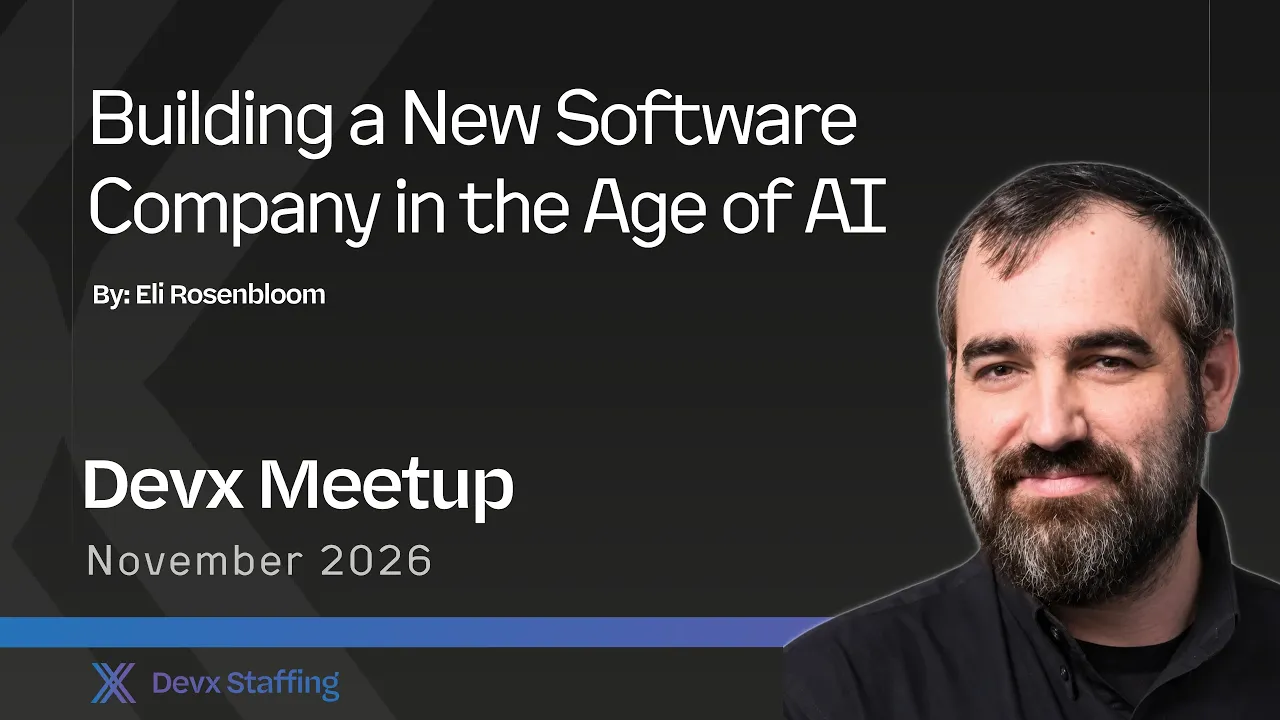
I've been in business about 25 years. Um, I started it as a medic. I started a commercial ambulance service almost 25 years ago. I did that for about 10 years, and if you wonder how you get from being a medic to being in software, there's a little bit of a path there. Um, I, I actually started working as a teenager for a commercial ambulance service for... One or, one or two of you in the crowd who may have known me all the way back in yeshiva, there was a time where I definitely did park an ambulance in, in the inner circle at, uh, Ner Yisroel. And I definitely had Rabbi Mintz come to me and say, "Is that your ambulance?" Which it was. Um, and then one day I had to go and buy a, an ambulance and, and, and then eventually I got into the wheelchair van business, and they were exceedingly expensive and... Um, a word of advice if you ever wanna start a business, not a bad way to start a business when you look at something and say, "Why is this so awful, and why is this so expensive, or why doesn't it work right, and how come they can't get that thing straight?" That's probably a really great place to start. Um, if you live in a world where you see something and it doesn't work the way you think it should or it doesn't, or it doesn't function the way you think it should, it's usually a good, uh, kind of grain to start with. And that is actually the, um, kind of the core principle in the various companies that I've started over the years. At this point, um, I've been involved in the startup for about nine different companies, and they range from, um, operations, manufacturing, real estate, couple of other different things. Um, and then from there, I woke up one morning and I said I was tired of dealing with, uh, EMTs and, and, and 2:00 in the morning issues with, uh, with medics hitting, uh, 911, uh, uh, hitting with Baltimore City, uh, Fire Department and all this other stuff and, and I said, you know, "I want something a little bit more peaceful." So I decided to start a little manufacturing company 'cause that's definitely more peaceful. And I figured, why not? I'll build the wheelchair vans that I, you know, didn't like the way the process worked. And I did that. We actually built that company, um, into the largest type two ambulance manufacturer in the world. Um, and I exited that a couple years ago. In the process of building that company, um, we scaled very rapidly, and as we scaled, uh, we found that, uh, it was an ongoing problem with the software that we were trying to develop. My first experience with B2B software probably goes back to about, uh, 2012, 2013. And anybody who has had the displeasure of having to deal with most of the B2B software companies knows they're exceedingly expensive. Um, customer support or customer service is not even a tertiary thing. It's actually, uh, it's a, it's a feature of how they work. They... with their poor customer service. I know some of you in the crowd here work for some of these big companies and know exactly what I'm talking about. And then, of course, the same question came through my head, which is, "Why is this so awful? Why is this so expensive? Why doesn't someone do something about it?" And of course, Noam and I have a long-standing habit for the past, um, I don't know, about 12 or 13 years, we try to make Tuesday night our game night. And in game night, uh, we try to take an hour off or two hours off and, and discuss and... uh, our stuff. And I spent a good long time, uh, complaining, I'll say that nicely, uh, could be used another word, um, uh, about, uh, how awful the experience is. Noam actually helped me, uh, work my way through some of cutting my teeth early on, and I asked the same question: Why doesn't someone do something about this? And eventually, I decided to do something about it. I got the crazy idea that being in software is a good idea. Um, still not sure that's a good idea. I'll let you know how it works out. Um, and we started this thing about... We really started it about three years ago. Um, we kinda started a little earlier than that. Um, and what we built is an ERP system. I'll give you my one plug for the night. It's omnisoft.com, if anybody's interested. Um, and, uh, I had, I had a couple of crazy ideas involved here. The idea was that, you know, software can operate like your local, you know, bakery, right? If you've got a really good bakery, um, you come back because, you know, it tastes good and things are good and like any other business. And I don't understand why people don't treat software the same way. I know software, bakery, not sure what they have with each other. Um, but I think a good business should be a good business, no matter what you're running. Um, you should take care of your clients. You should provide a good service. You should provide a good product. Um, and, um, and that's kind of the core of what we try to do. And it doesn't matter whether you're in software. It doesn't matter whether you're, um, in something else. It's the, the, the dynamics don't change. What has changed is the software industry itself. So about three, three and a half years ago, as we started getting ready with this stuff, um, it was basically impossible to hire somebody in software. We, we would go through situations where we would meet these kids that are practically out of diapers, that don't really know anything about, um, the world they live in, and they have some sort of degree from some sort of institution of questionable worth, and they would demand six... deep six-figure salaries, and I would kind of combination laugh and cry. I don't know if it was halfway, which way. I don't know if you guys have ever experienced any of this. Um, it was a different world. And if you fast-forward to now, um, three, three and a half years later, um, the industry's changed. It's, it's changed a lot Um, and, um, number one, it's gone from being a seller's market to being a buyer's market. Um, it's changed. It, it's, it's very much changed. The dynamic has changed. Um, where before you can ask for anything and someone would hire you for just about anything, now you have-- definitely have to prove your worth. Um, that's not to say that software is a dead space. Um, to the contrary, um, I happen to think that it's more dynamic than it's ever been. Um, the value and the cost of knowledge has never been cheaper than it is now in the entirety of human history. And if you don't understand that, then you're missing out on the core prospect here. What I find is happening is not that the space is not-- is a dead space. It's as dynamic, more dynamic than it's ever been. Um, what is actually happening is there's a bifurcation. There's a bifurcation in the workforce. Um, what you're seeing is there's a very, very small percentage, something around ten, maybe twelve percent, um, and that I just took that number out of my back pocket, so I'm making it up as I go. Um, but there's a very small percentage of individuals who are adapting to the technology very, very rapidly. And as they adapt to the technology, their value is becoming astronomical. They are sought after. They are extremely well compensated. They are wanted everywhere. And if you want to play in this space, you're going to have to be inside of that twelve percent, ten, twelve percent Um, if you're not, you're gonna fall into the other 90, and the other 90 is where everybody else has traditionally lived. You always needed warm bodies to check your code. You always needed warm bodies to do your monkey testing. I know, I don't know if anybody's a monkey tester here. I apo- apologize for, uh, for using that term. Um, but you've always needed, um, like this manpower to do these things, and now that manpower, that low-value manpower or that medium-value manpower, now that's not an asset. It's a liability. To any company to move, there's a frictional cost with every individual you add. Um, I didn't make this up. There's actually a whole kind of diagram that connects how many connections you have. So if you have two people, you have one connection between them, but if you have three people, you have three connections, and then if you have a fourth person... And it grows exponentially, and each one of those connections creates a frictional point and creates friction inside of your company, which means that low-value people actually become a hindrance, not a help. And so if you wanna be on the side of the winning side, if you wanna be in demand, you have to be inside of that space. Um, and that space is small, but it's exceedingly valuable, and I believe what will happen over the next, um, over the next Three or four years, maybe even sooner, is you're going to see a lot of people bleed out of the space because they won't be able to keep up. And when I say keep up, I really do mean keep up. Um, I assume most of the people in this room are pretty nerdy and pretty techy. Um, I could tell you from my perspective, when a new model drops, when new technology is out there, I am on the phone with Noam, and we're talking about have we benchmarked it? Where is it at? What can it do? And the reality of it is, is that we are doing things today that weren't possible eight weeks ago, okay? If you're talking about what you know about from half a year ago or a year ago, you're talking about ancient history. If you're talking about the hallucinations that something had and the way you tried to make the thing work or whatever it is, you're outdated, okay? I mean, if you look at where you're at, the space is moving that fast, and if you wanna stay on top of your capacity to perform in the space, that's gonna be the big change. And in my professional experience, with my-- in my, in my, in my business experience, um, the biggest thing that I've found is the big don't win. Um, it's the fast that win, right? If you move fast, if you are truly agile, not agile in the corporate way, but agile in the real way 'cause, you know, corporate likes to drop agile. We're going agile, right? You know, anybody here, raise your hand if you've, if you've heard that term in your workplace. Okay. Yeah, okay. Yeah. No, I don't mean that way, but I mean in the term, in the sense of being on the edge. If you're on the edge, you're gonna make yourself enormously valuable. I believe that value is gonna stay because there's a gap between what the systems can do and where you need human intelligence and human intuition, and that gap is incredibly important, and I don't see that gap narrowing. I haven't seen that gap narrowing even as the capabilities of the underlying systems have, have, have become amazing. There's still that piece, and if you leave it out, you're gonna end up with a spaghetti pile of garbage. So I'm gonna leave off with one last thought. If you're not doing anything else Okay? Take at least a few minutes out of your week, out of your month, and try to see what is the latest, and don't read about it. Don't watch a YouTube movie about it. Try it. Okay? Don't trust the guy that was paid by, by GPT or by Claude or by whatever to tell you how amazing, you know, Gemini 4.0 Argon is or whatever it is, right? Try it. Uh, build something. Test something, right? Be on the edge. Um, if you find yourself in the marketplace, and I assume some of the people, um, in this a- audience are, you know, are looking, might be looking or worried about looking or worried about where they're going, be knowledgeable. Know what they are. And don't know from secondhand experience or from something you watched. Know it because you tried it. 'Cause I can tell you what you try and what is real and what is spoken and what is out there and advertised are two entirely different realities. And if you find yourself in the marketplace, if you find yourself, um, looking for a job, needing a job, wanting a job, wanting a change, whatever the case may be, your best position is going to be to be on the edge, right? Um, and I can tell you, we're hiring... You know, we still hire. It's not like we don't hire. Um, but when Noam comes to me and he says, "Hey, I want this engineer," and we just hired somebody, and we just hired somebody from South Africa, and they were very pricey for that marketplace. And we pay based on the marketplace that we hire in. We, we have engineers in 13 different time zones. Um- My response is I, I, I don't tell him no. I don't tell him, you know, "This is too high a price," or whatever the case may be. What I tell him is, "At that price, they better be that good." Okay? So if you wanna turn around and say, "Hey, I'm-- I could be in that space," you had better be that good. And I told Nam, "You hire Eric, Eric had better be that good." And Eric knows that he needs to be that good, and Eric is that good actually. Um, but that's the point, right? And the, and the way to be there is to be on the edge. And I actually have a couple of really smart engineers that are, that are not on the edge in the way they're working, and we're looking at them and we're saying, "Mm," right? Like you, uh, what you knew was great six months ago or a year ago, but you have to be there today, and you have to be... And, and from a software perspective and e- as an executive, right, when I'm looking at an employee, I'm looking at cost per feature, right? If I throw out a new, a new program, a, a new feature, a new whatever, I'm looking at, you wanna make this change, it costs this much. And if that guy can do it in a fraction of the time and better, and better tested, and more reliable, and more stable than you can, then that's what it comes down to. A- and the difference isn't small. To illustrate the point, uh, we are getting ready to deploy a new piece of software inside of our software. We built an ERP system, and part of it has a shipping component where you, where a tenant can ship out inventory. And we pride ourselves on our mobile applications, and we're building out a component of this for the mobile application. We gave it to one of our mobile teams. Um, and this is a team, team of six people, right? Very experienced engineers. Some of them have been in this space for decades, right? All would've been considered extraordinarily valuable at their s- their, their pace, their speed, their, their place just, um, you know, just a year or two ago. And we asked the team leader for an assessment of how many dev days he would need to deploy this particular component, bearing in mind that on average he's about 20%, uh, understated. So if he tells me a number, I'm adding 20% to it on the bottom line just, just, just, you know, Ɣtāḥles right there. And he quoted, roughly speaking, 100 dev, dev days. And I gave it to Eric, and Eric will handle it in 10 days. Okay? And so then ask me, "If Eric makes two or three times what the other engineers make, is Eric worth it?" And the answer is absolutely. Because if he's twice as expensive and a tenth the time, and his product is gonna be better because he'll have put in all the automated tests. Um, and when I say automated test, I don't mean your standard CI/CD pipeline. I mean what you can do in testing today, for those of you who are trying the edge of this in-browser testing, all the monkey testing with beautiful outcomes that are referring back to our database, that are checking everything automatically, running loops that are updating, creating PRs that are gonna fix those things, like working in a highly agentic, highly structured way. You need to be the Eric, and if you're the Eric, then you're going to do well, and I think you'll continue to do well if you utilize... It's kind of like a F1 car. I don't know if anybody here ever follows F1, right? The average driver, if you get into an F1 car, you're gonna drive it worse than your Accord, right? Most people will drive their Accord faster than an F1 car. But if you know how to drive an F1 car, then you can drive it so much faster than anyone else, and that's really what you need to learn to do, and you need to stay on the edge of that. I talked way too much, way more than I planned on. I planned on about seven minutes, and then I just went on and on and on. I have this problem. I'd like to introduce my very best friend in the world, Noam Alper. He's the guy who actually knows this stuff, and he's the guy who'll probably teach you about something that you didn't know.

